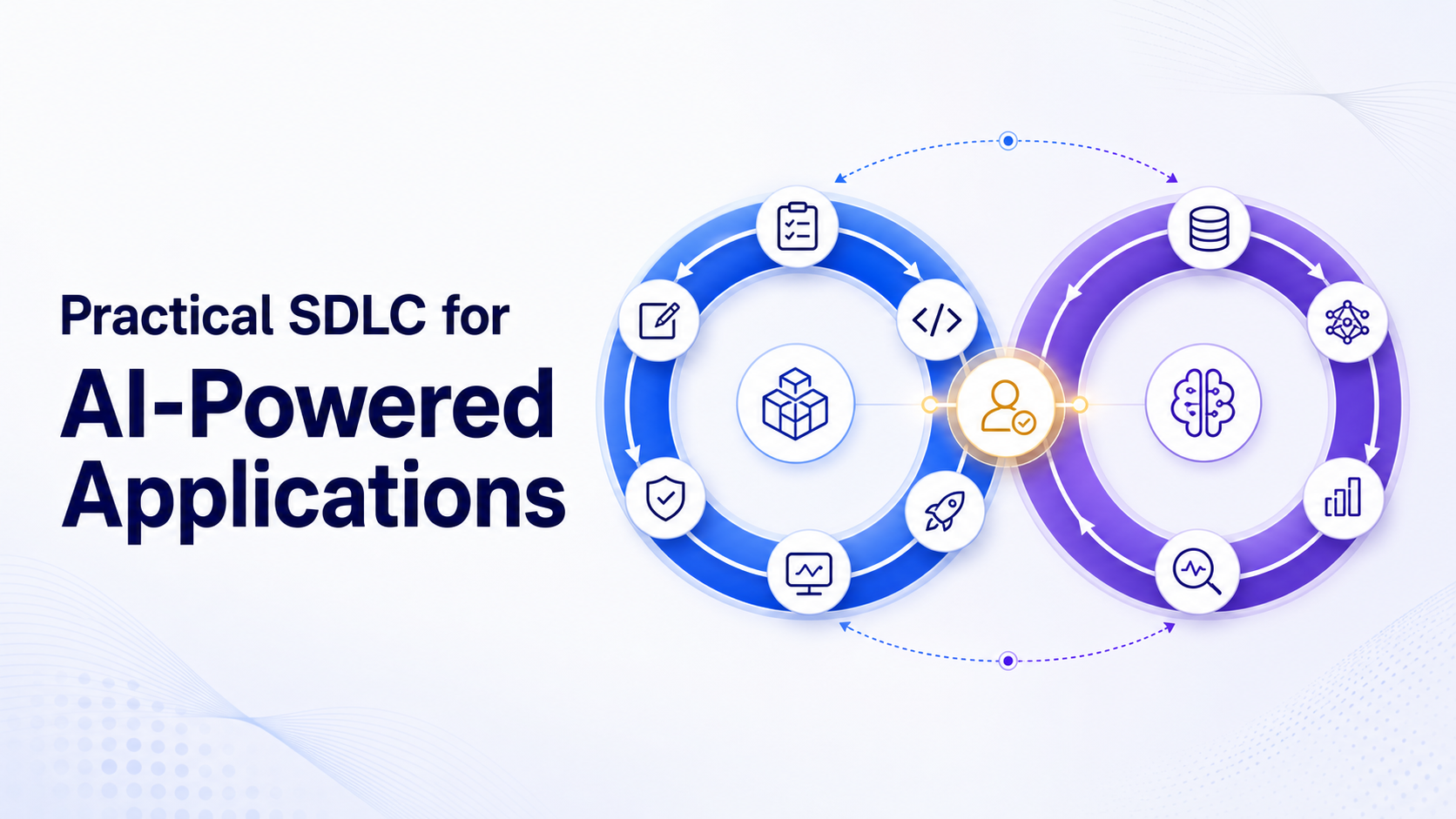
Building an AI-powered application requires more than adding a model to a traditional software project. Teams must manage code, prompts, data, models, and AI behavior as connected parts of the product.
This practical framework combines:
- Agile Scrum for short iterations, prioritized backlogs, and regular stakeholder feedback.
- DevOps for continuous integration, automated delivery, monitoring, and recovery.
- AI engineering and MLOps for versioned prompts, data, models, evaluations, and behavioral monitoring.
The Dual-Loop Model
Work moves through two synchronized loops:
- Application loop: User experience, APIs, business logic, prompts, and integrations.
- AI/model loop: Data, retrieval, model configuration, evaluation, and optimization.
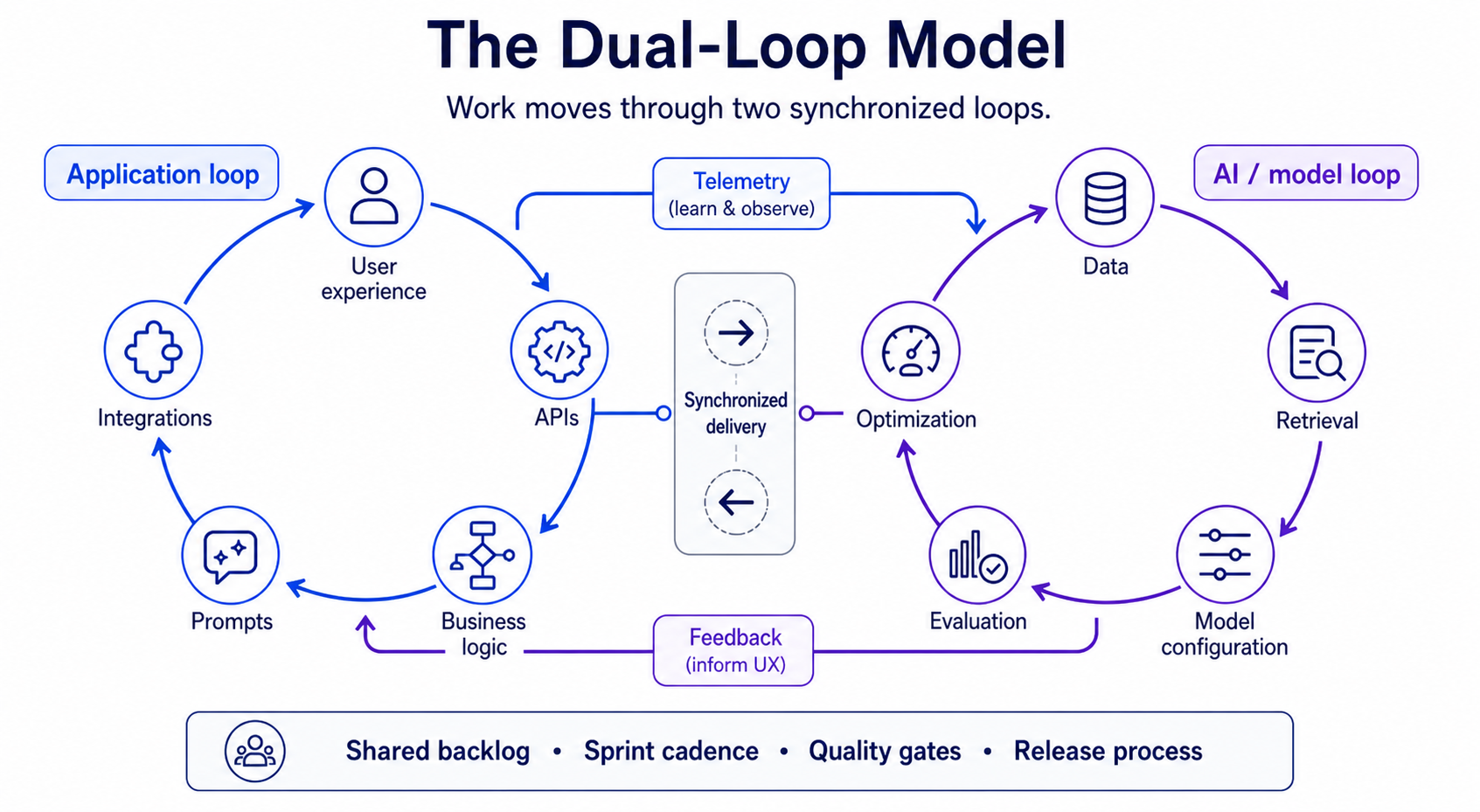
Both loops use the same backlog, sprint cadence, quality gates, and release process.
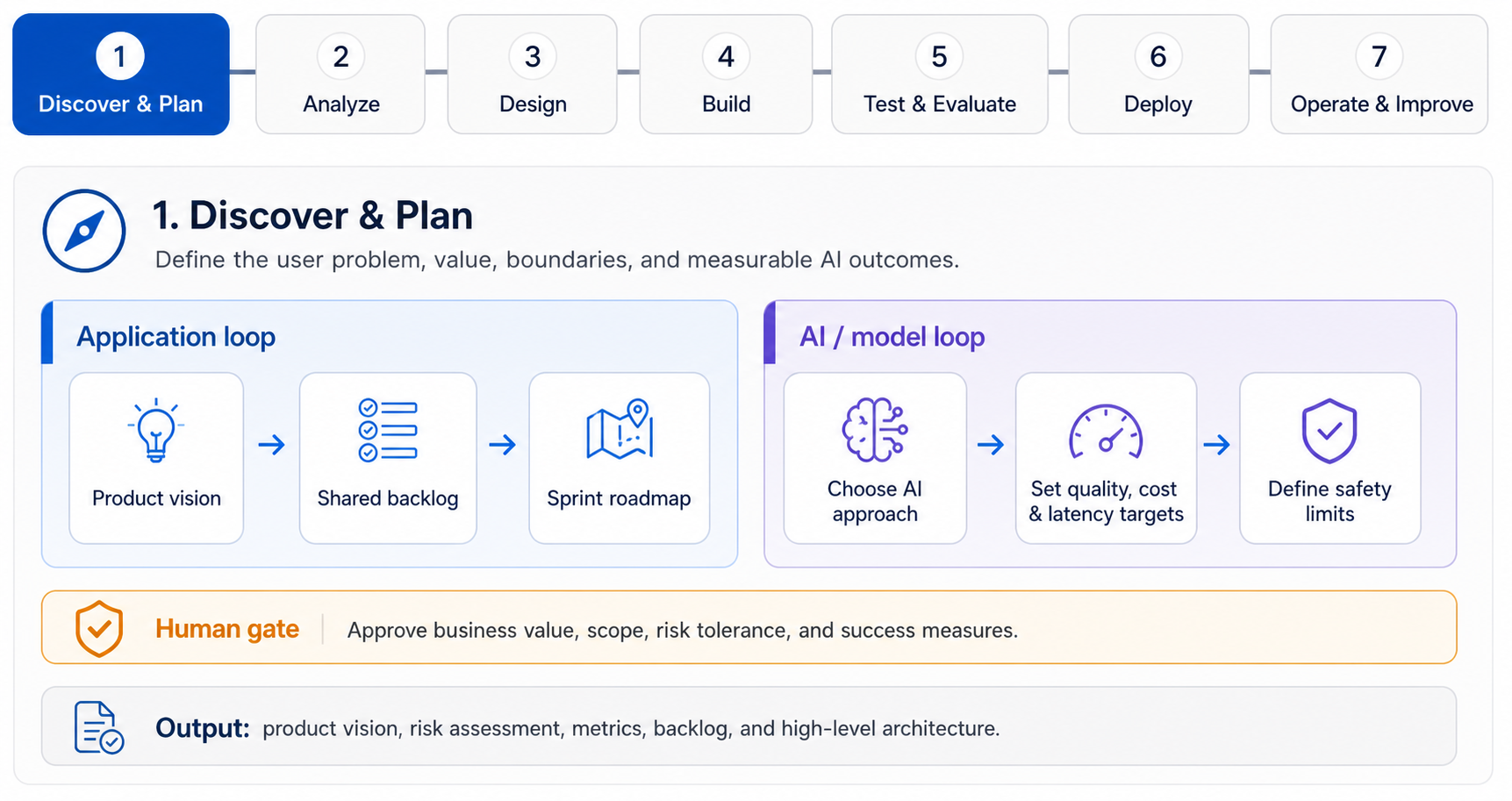
1. Discover and Plan
Define the user problem, expected value, scope, risks, and measurable outcomes.
For an AI-powered application, determine:
- The user problem the AI will solve.
- Whether the solution needs an LLM API, retrieval-augmented generation (RAG), fine-tuning, or a combination.
- What information the AI may access.
- Expected accuracy, latency, and operating cost.
- When the application must use a safe fallback or escalate to a person.
- What the AI must never do.
Example measures
- At least 85% of evaluated answers are correct.
- Fewer than 2% of responses contain unsupported claims.
- The 95th-percentile response time is below five seconds.
- Average model cost remains below an agreed amount per conversation.
Human gate: Product and technical leaders approve the business case, scope, risk tolerance, and success measures.
Output: Product vision, risk assessment, success metrics, initial backlog, and high-level architecture.
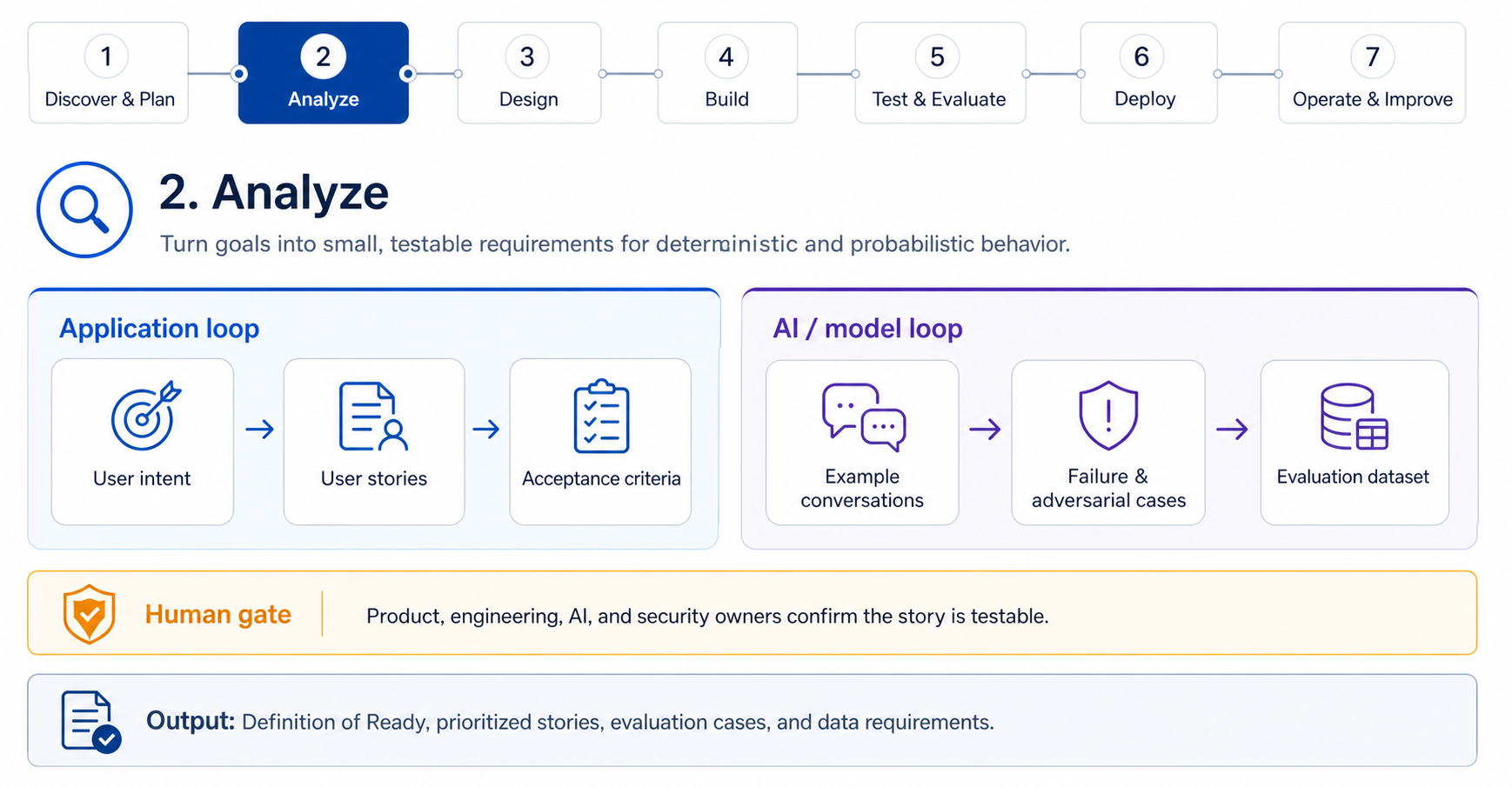
2. Analyze and Define Requirements
Convert product goals into small, testable user stories that cover both software behavior and AI behavior.
Each AI feature should specify:
- User intent and expected outcome.
- Functional acceptance criteria.
- Example inputs and expected responses.
- Error, boundary, and adversarial cases.
- Privacy and security requirements.
- Accuracy, latency, and cost thresholds.
- Fallback and human-escalation behavior.
Example user story
As a customer, I want the assistant to answer questions using approved support documents so that I receive accurate product information.
Acceptance criteria should confirm that answers use approved sources, protect private data, meet latency targets, and fall back safely when evidence is insufficient.
Human gate: Product, engineering, AI, and security owners confirm that the story is clear and testable.
Output: Prioritized stories, acceptance criteria, evaluation cases, data requirements, and Definition of Ready.
3. Design the Application and AI System
Design the deterministic application and probabilistic AI behavior as one integrated system.
Application design
- User experience and conversation flow.
- Authentication and authorization.
- APIs, storage, and external integrations.
- Error handling and fallback paths.
- Logging, monitoring, and deployment architecture.
AI-system design
- Model and provider selection.
- System prompts and prompt templates.
- Context-window and token budgets.
- Retrieval, ranking, and data sources for RAG.
- Safety filters and confidence thresholds.
- Evaluation datasets and quality measures.
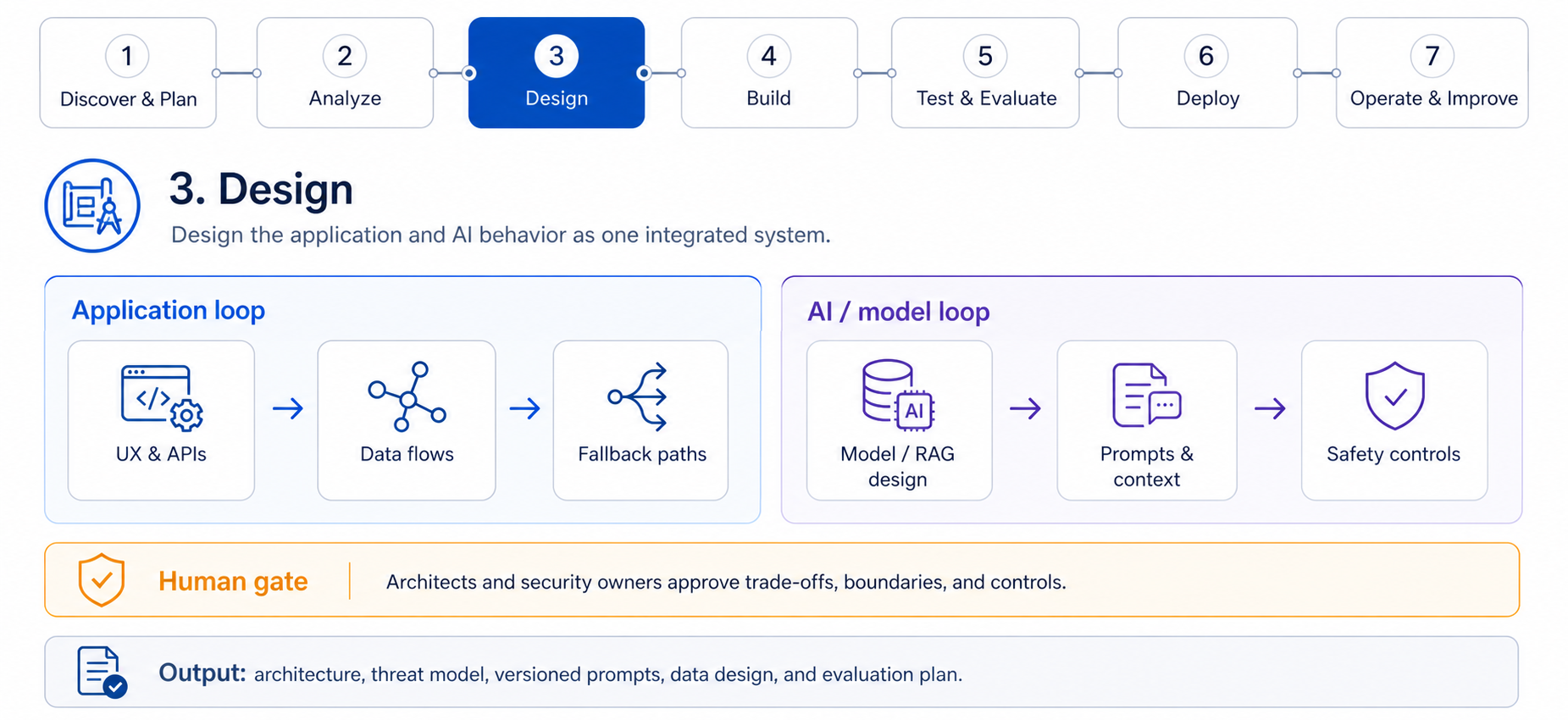
Version architecture decisions, prompts, schemas, and evaluation criteria in source control.
Human gate: Architects and security owners approve the design, boundaries, and trade-offs.
Output: Architecture diagrams, threat model, prompt design, data flow, evaluation plan, and deployment strategy.
4. Build in Short Scrum Sprints
Use one- or two-week sprints to deliver small, demonstrable increments.
A typical sprint follows this sequence:
- Select application and AI stories from the shared backlog.
- Define tests and AI evaluation cases before implementation.
- Use AI coding assistants to draft code and tests.
- Inspect, secure, and refactor generated code.
- Version prompts, data references, and model configuration with the code.
- Demonstrate the feature using realistic success and failure scenarios.
- Add feedback and newly discovered risks to the backlog.
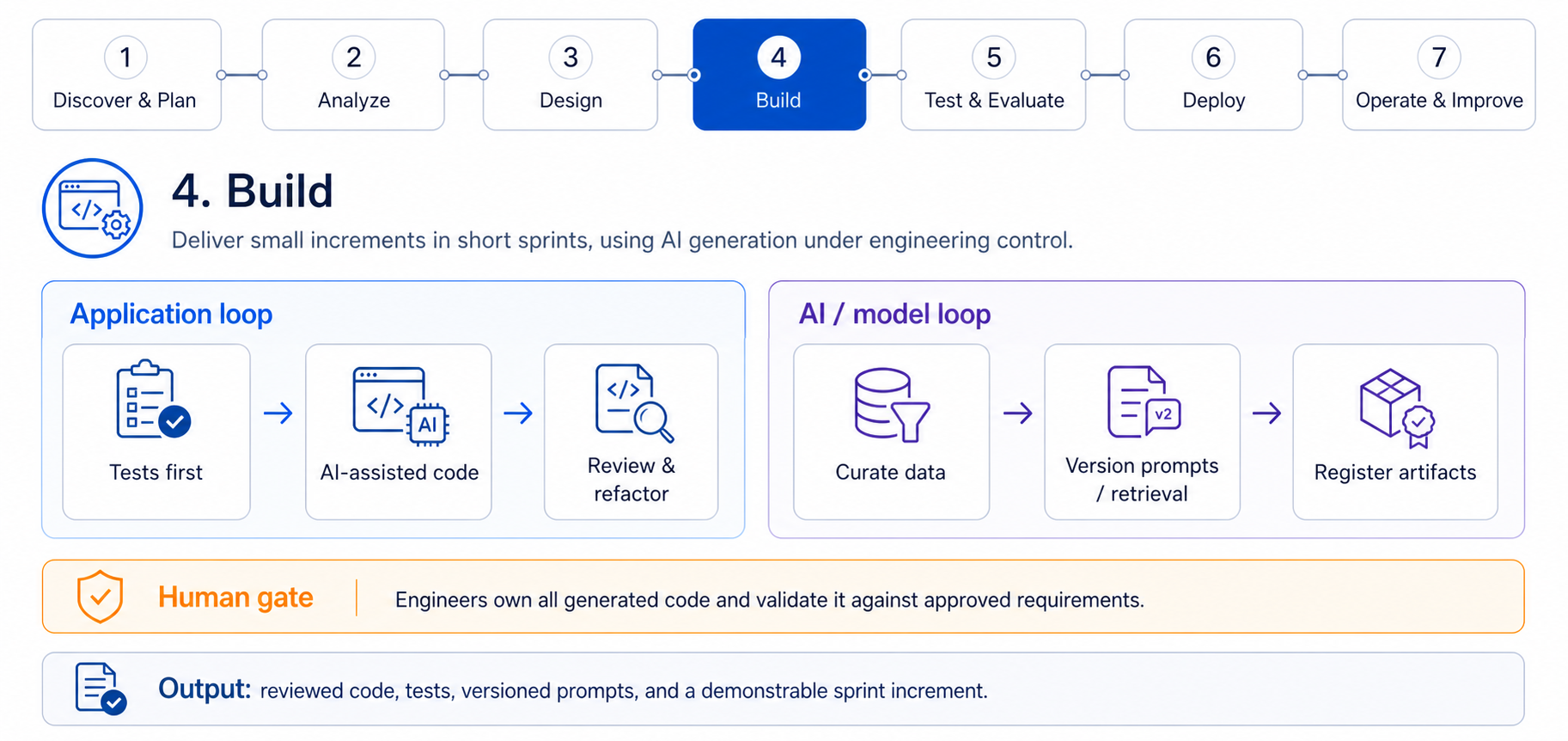
When using RAG or custom models, the AI/model workstream simultaneously curates data, updates retrieval or model behavior, and registers versioned artifacts.
Human gate: Engineers remain accountable for the security, correctness, and maintainability of all generated code.
Output: Reviewed code, automated tests, versioned prompts and AI artifacts, and a working sprint increment.
5. Test and Evaluate
Traditional tests verify whether the software works. AI evaluations verify whether the AI behaves acceptably.
Application testing
- Unit and integration tests.
- API and end-to-end tests.
- Authentication and authorization tests.
- Load, accessibility, and resilience tests.
- Dependency and vulnerability scans.
AI evaluation
- Correctness and relevance.
- Groundedness and hallucination rate.
- Retrieval quality.
- Prompt-injection resistance.
- Bias, toxicity, and harmful output.
- Privacy and data leakage.
- Latency and token cost.
- Behavioral changes between versions.
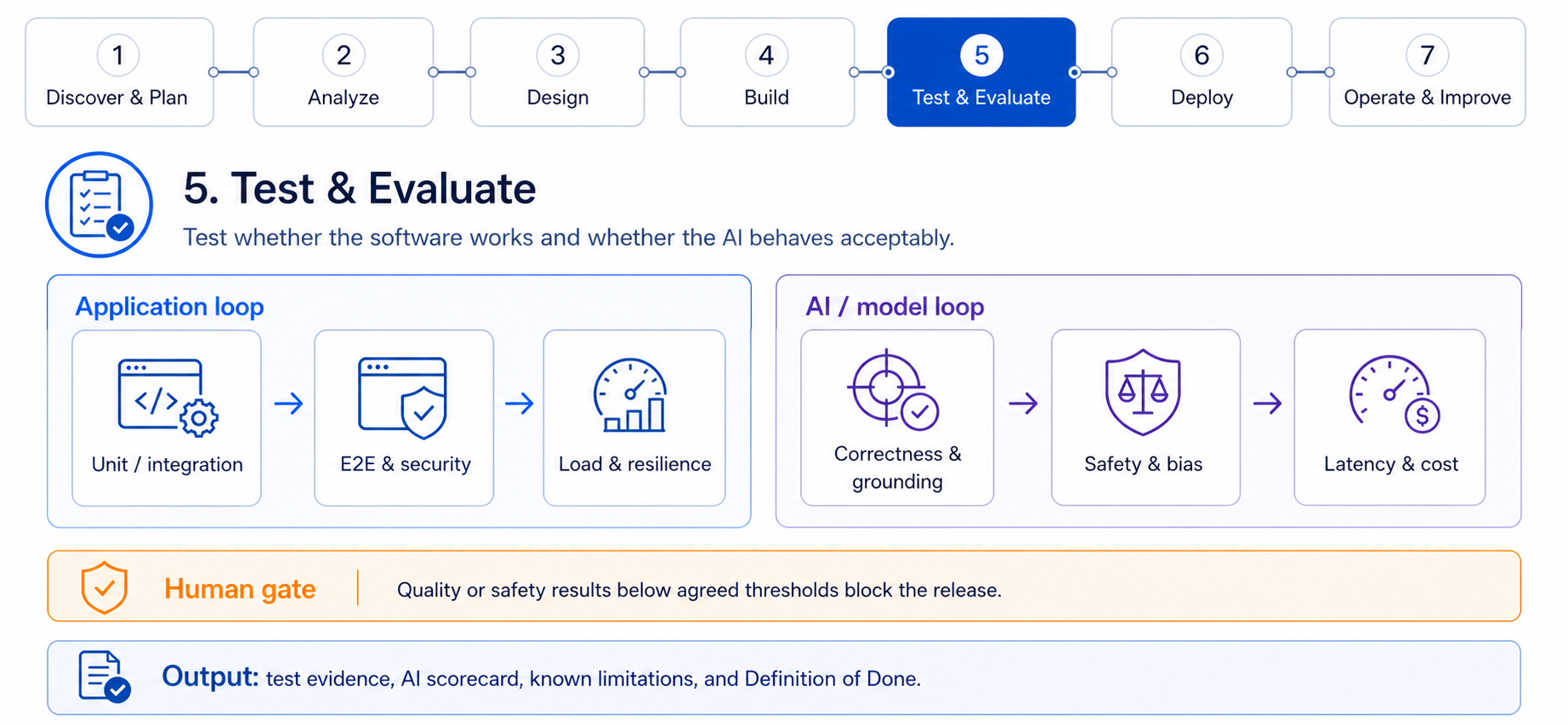
Maintain a fixed, versioned evaluation dataset so results can be compared over time.
Human gate: Results below agreed quality, security, or safety thresholds block the release.
Output: Test results, AI scorecard, known limitations, security findings, and Definition of Done evidence.
6. Integrate and Deploy Safely
Package the application code, prompts, configuration, retrieval assets, and model references as one traceable release.
The delivery pipeline should:
- Build and test the application.
- Run AI evaluations against the candidate version.
- Scan generated code and dependencies for vulnerabilities.
- Validate prompts, schemas, and configuration.
- Register approved data and model versions.
- Deploy to staging.
- Release through a shadow, canary, or feature-flag deployment.
- Roll back when defined failure thresholds are crossed.
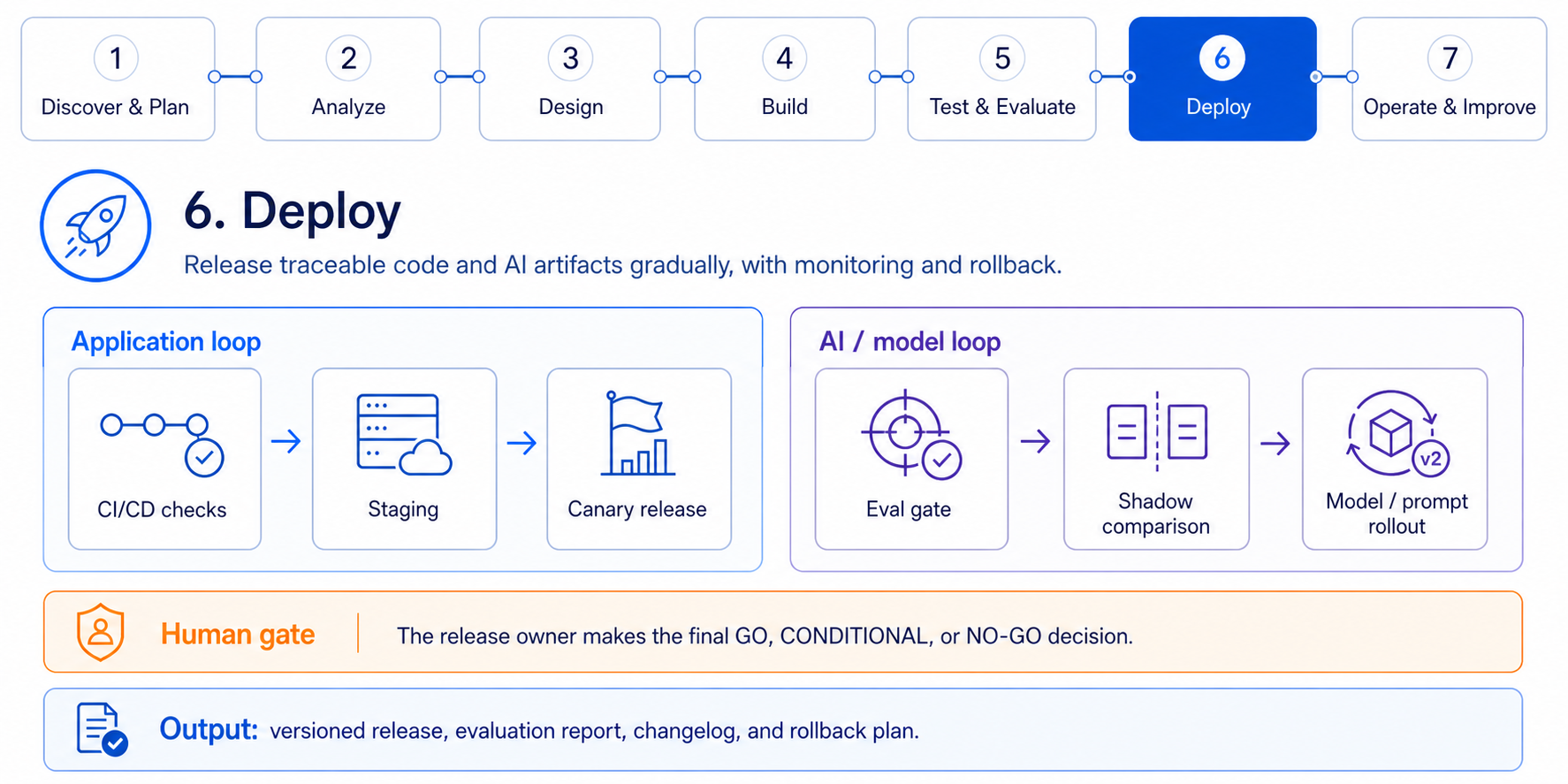
A shadow deployment allows a new AI version to process real requests without showing its responses to users. The team can safely compare it with the active version.
Human gate: The release owner makes the final GO, CONDITIONAL, or NO-GO decision.
Output: Versioned release, evaluation report, deployment record, changelog, and rollback plan.
7. Operate, Learn, and Improve
Monitor the complete product after release and feed validated learning into both development loops.
Track:
- Availability, errors, and response times.
- Model latency and token costs.
- User feedback and escalation rates.
- Unsupported or low-confidence answers.
- Prompt-injection attempts and safety violations.
- Retrieval failures and stale knowledge.
- Quality changes by prompt, data, or model version.
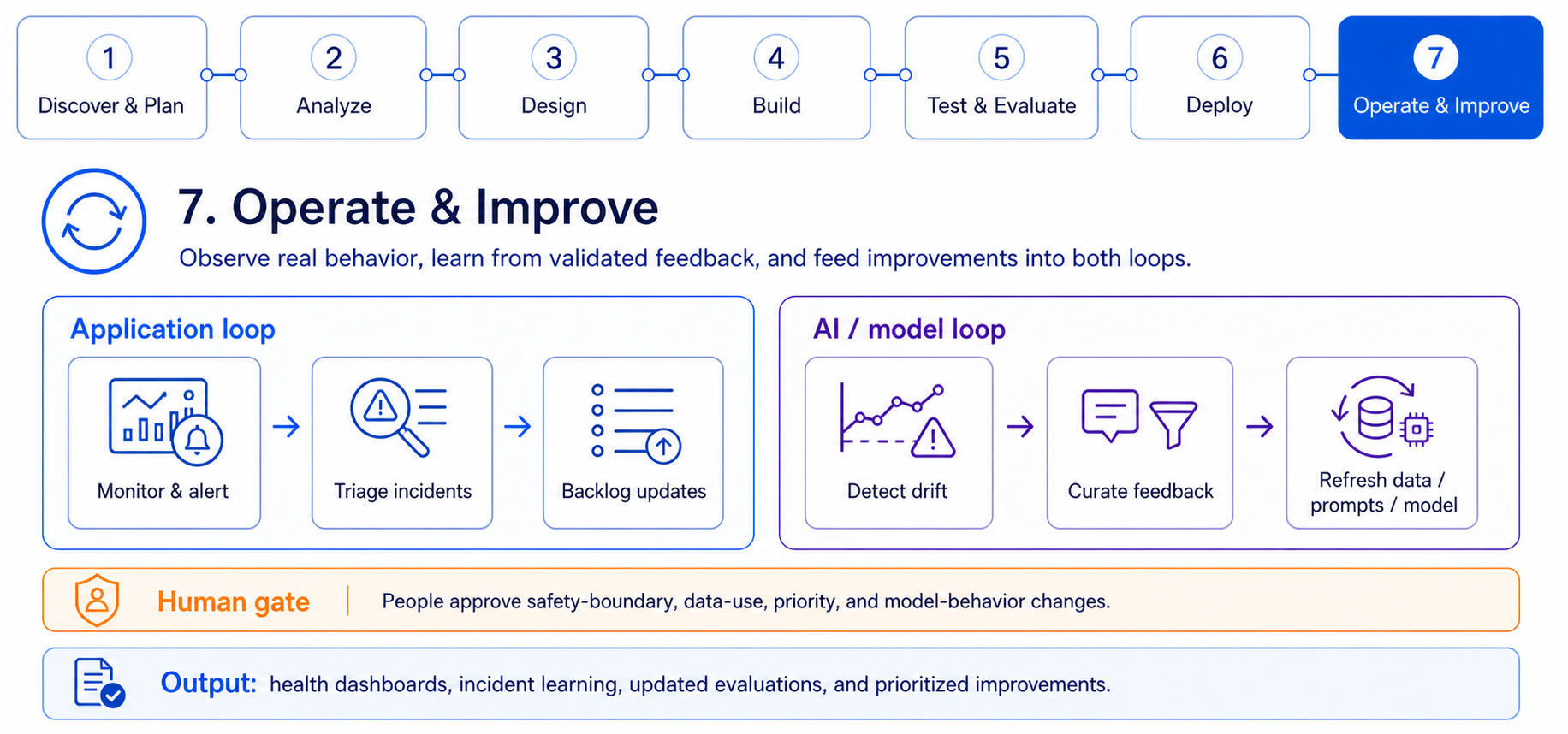
Monitoring can trigger a safe response, deterministic fallback, human escalation, or rollback. Only validated and appropriately protected production interactions should become evaluation or training data.
Human gate: People approve changes to data use, priorities, safety boundaries, and model behavior.
Output: Operational dashboards, incident learning, updated evaluations, and prioritized improvements.
Recommended Delivery Cadence
- Daily: Application and AI engineers review delivery blockers and quality signals together.
- Every sprint: Deliver an integrated product increment and AI evaluation report.
- Sprint review: Demonstrate successful, failure, and fallback scenarios.
- Retrospective: Review delivery speed, defects, hallucinations, cost, and operational issues.
- Every release: Apply security, quality, cost, and rollback gates.
- Monthly or quarterly: Refresh prompts, evaluation datasets, architecture documentation, and governance rules.
Core Operating Rules
- Test before generating. Define software tests and AI evaluation cases before implementation.
- Audit AI-generated work. Engineers own the security and correctness of generated code.
- Version everything. Track code, prompts, data, evaluations, retrieval configuration, and model versions.
- Release progressively. Use shadow, canary, or feature-flag deployments for significant AI changes.
- Design safe fallbacks. Low-confidence or unsafe behavior must lead to a safe response or human review.
- Measure behavior continuously. Passing code tests does not prove that an AI feature works correctly.
- Keep critical decisions human-owned. AI provides evidence and recommendations; people approve scope, architecture, risk, and releases.
Conclusion
An effective AI-powered SDLC does not replace Scrum or DevOps. It extends them. The team continues to plan iteratively and deliver continuously, while adding disciplined management of prompts, data, models, evaluations, and AI risk.
The result is a development process that moves quickly without sacrificing traceability, safety, or human accountability.