
Risk of Vendor Lock-in with LLMs
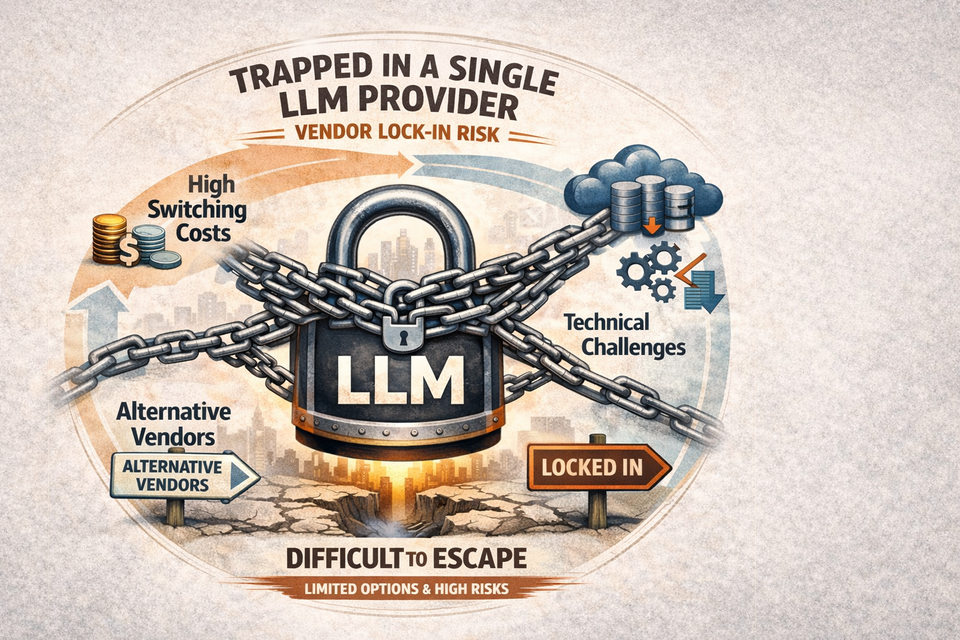
The risk of vendor lock-in with Large Language Models (LLMs) is a significant, often underestimated, strategic and financial risk for businesses. As organizations automate tasks, they risk becoming deeply embedded in a single vendor's ecosystem, making it prohibitively expensive or technically difficult to switch to a competitor.
The Realities of LLM Lock-In
- API and Model Dependence: Systems often become dependent on a specific provider's API, prompt formatting, and model "quirks".
- Prompt IP and Tuning: Intellectual property developed in prompts, fine-tuning, and specialized embeddings (RAG) is rarely portable between providers (e.g., swapping OpenAI for Anthropic).
- Operational Dependence: Over time, tools, monitoring, rate limits, and security guardrails become tied to one vendor’s console.
- Hidden Costs: While initially inexpensive, reliance on one vendor can lead to high, unexpected costs due to price hikes, as the vendor gains leverage.
- Skill Erosion: Relying on automated AI for tasks can lead to a loss of workforce expertise, creating dependency on the system.
Risks to Business Continuity
- Single Point of Failure: If your vendor experiences an outage or changes its terms of service, your automated processes may halt.
- Innovation Stagnation: Switching to a better, faster, or cheaper model becomes too difficult, forcing you to stick with outdated technology.
- Data Privacy and Sovereignty: Sending sensitive, proprietary data to external, third-party APIs can lead to leaks or compliance issues.
Strategies to Mitigate Lock-In
- Architect for Exit: Treat LLMs as replaceable components rather than the foundation of your architecture. Use abstraction layers to separate application logic from the model API.
- Adopt Multi-Model/Hybrid Strategies: Use different providers for different tasks or maintain a "backup" model, leveraging open-source (like LLaMA or Mistral) for critical or private data, and commercial APIs (like GPT or Claude) for general tasks.
- Portable Data and Prompts: Keep your data format and prompt engineering independent of any one provider's specific style or proprietary tools.
- Use AI Gateways: Implement AI gateways (e.g., Portkey, LangChain) to standardize requests and routing across multiple providers, allowing for easier switches.
Summary: While LLMs provide significant automation benefits, treating them as a plug-and-play utility can lead to a dangerous, long-term dependency. A "lock-in-aware" strategy—designing for portability from day one—is essential for long-term sustainability.