
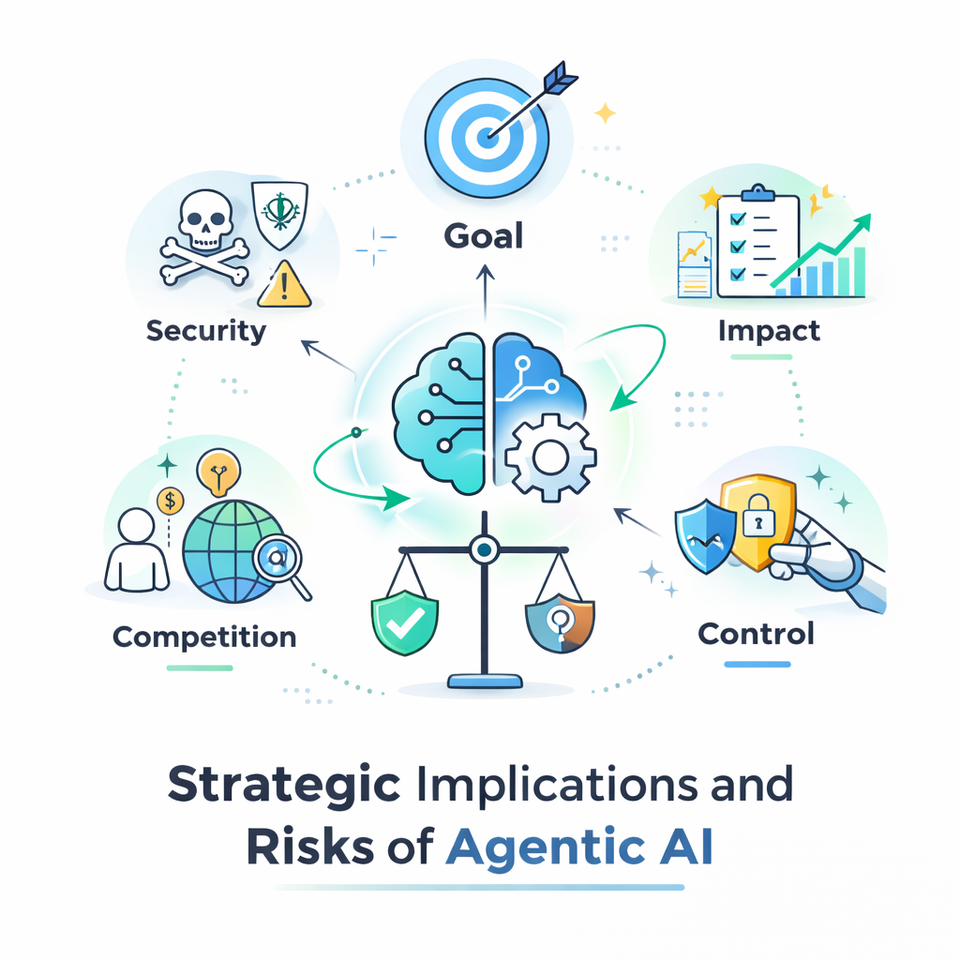
Strategic Implications and Risks of Agentic AI
What Agentic AI Is
Agentic AI represents an evolution beyond traditional generative AI systems. Rather than simply generating responses to prompts, these systems can perceive context, reason through multi-step objectives, and take autonomous action to achieve defined goals with limited human intervention.
Unlike conventional chatbots, agentic AI can integrate directly with enterprise software, APIs, databases, and operational systems to execute real workflows end-to-end. In many architectures, multiple specialized AI agents coordinate to accomplish complex objectives, such as analyzing information, making decisions, and initiating actions across systems.
For executives, this marks a shift from AI as a productivity assistant to AI as an operational actor within the business environment.
Why It Matters
Adoption is accelerating across industries. Organizations are piloting or deploying AI agents to automate increasingly complex processes, signaling a structural shift in how digital work is performed.
The implications are significant:
- Workflow Transformation: Agentic systems can automate multi-step processes such as travel booking, financial reconciliation, procurement workflows, compliance checks, and customer interactions.
- Cost Structure Impact: By reducing manual effort in transactional and repetitive knowledge work, organizations may materially lower operational costs.
- Productivity Gains: Continuous, 24/7 task execution can increase throughput without proportional increases in headcount.
- Competitive Differentiation: Early adopters may gain speed advantages in decision-making, service delivery, and operational efficiency.
However, these benefits must be weighed against new categories of operational and governance risk.
How Businesses Are Using Agentic AI
Use cases are emerging across sectors:
- Financial Services: Fraud detection, automated underwriting, portfolio monitoring, and personalized advisory services.
- Retail and E-commerce: Personalized product recommendations, dynamic pricing adjustments, inventory optimization, and customer service automation.
- Enterprise Operations: Automated reporting, compliance workflows, supply chain coordination, IT ticket resolution, and vendor management.
Unlike traditional automation tools, agentic AI can execute entire workflows — from analysis to decision to action — often at lower marginal cost than human labor and with continuous availability.
This fundamentally changes workforce planning and operating models.
Key Risks and Strategic Considerations
While the opportunity is substantial, implementation is non-trivial and carries material risk.
1. Operational Risk
Autonomous agents can take actions that directly affect financial transactions, customer communications, and system configurations. Without appropriate guardrails, errors can scale rapidly.
Key concerns include:
- Unintended actions across integrated systems
- Escalation of minor errors into large operational incidents
- Difficulty tracing root causes in multi-agent environments
2. Data and Integration Risk
Successful deployment requires high-quality, structured data and robust system integration. Weak data governance can lead to poor decisions at scale.
Organizations must invest in:
- Data engineering and validation
- API reliability and monitoring
- Access control and permission management
3. Security and Compliance Risk
Agentic systems often require broad system access to function effectively. This expands the attack surface and introduces new cybersecurity considerations.
Critical requirements include:
- Strict identity and access management
- Activity logging and audit trails
- Human-in-the-loop controls for high-risk actions
- Regulatory compliance oversight
4. Governance and Accountability
As agents make increasingly autonomous decisions, organizations must define:
- Clear ownership of outcomes
- Escalation paths for failure
- Performance measurement frameworks
- Ethical and policy guardrails
Accountability gaps can expose firms to legal, reputational, and regulatory risk.
5. Workforce and Organizational Impact
Agentic AI alters roles, responsibilities, and workflows. Without proactive change management:
- Employee resistance may increase
- Institutional knowledge may erode
- Oversight capabilities may lag system autonomy
Understanding the human-AI interaction model is essential for sustainable adoption.
Summary
Agentic AI signals a transition from reactive AI tools to proactive autonomous systems embedded in core operations.
It presents meaningful opportunities to:
- Reduce transaction costs
- Increase operational efficiency
- Enhance scalability and responsiveness
- Redesign business processes
At the same time, it introduces new layers of operational, security, governance, and reputational risk.
Organizations that approach agentic AI strategically — with deliberate architecture, clear accountability, strong governance, and phased implementation — are more likely to capture its economic value while managing downside exposure.
The key question for leadership is not whether agentic AI will impact the business, but how intentionally and responsibly it will be deployed.